Much of the AI conversation focuses on what models can generate: text, code, images and complex reasoning. But a surprising amount of what businesses need from AI isn't generation. It's judgment.
Is this customer likely to churn? Which department should handle a request? How well does a company match our ideal customer profile? How luxurious is a particular brand?
These aren't new problems. Businesses have tackled them using traditional machine learning, embedding similarity, rules engines and, more recently, large language models (LLMs). But each approach brings its own development overhead, costs and limitations.
In the span of three weeks, TypeSafe AI, OpenAI and Cloudflare have introduced dedicated decision model offerings. We think these releases are more significant than they might initially appear, particularly for organizations looking to build practical AI systems.
Three approaches to the same problem
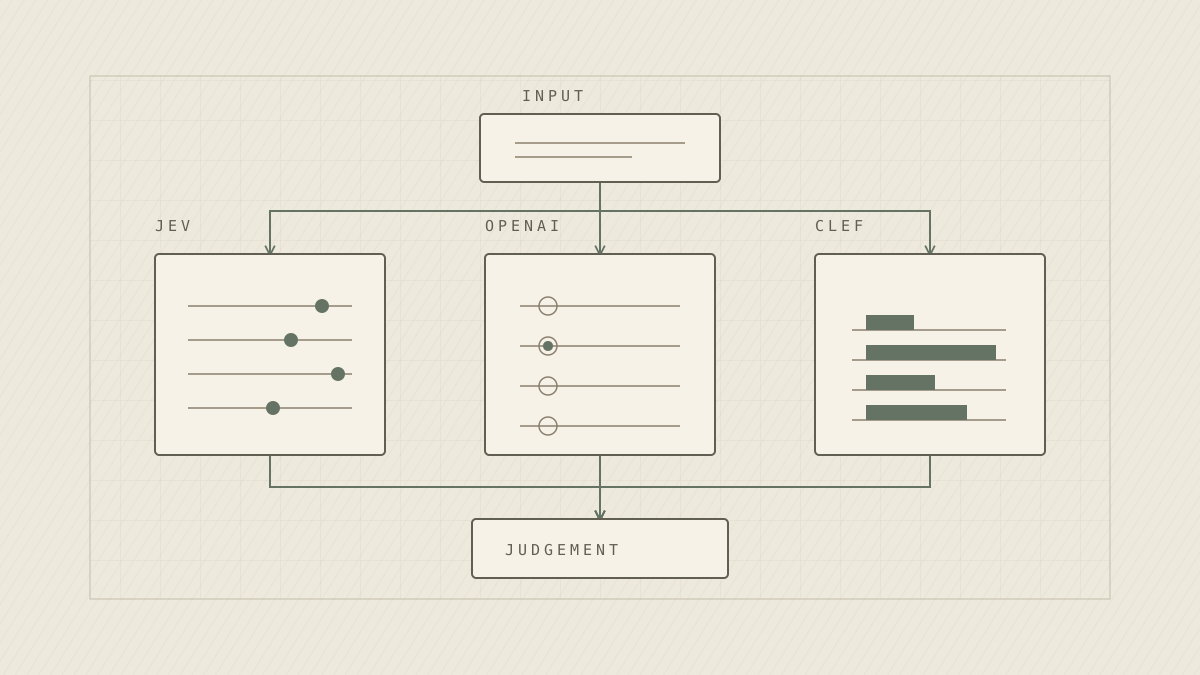
On September 15, TypeSafe AI introduced Jev, its first System One model. Rather than generating text, Jev returns structured decisions and probabilities. TypeSafe built a specialized architecture and training method called Reinforcement Learning for Calibrated Decisions (RLCD), with an emphasis on speed, cost and probability calibration.
OpenAI followed with its Decisions API, announced in late September and made publicly available in beta on October 6. Powered by GPT-6 Luna, it supports three decision types: predicates, choices and numerical scores. Unlike Jev, it also accepts images. OpenAI advertises decisions up to ten times faster than using Luna through its conventional Responses API.
On October 1, Cloudflare released Clef and Clef-flash. These models offer similar decision capabilities, including image support, but with a particularly interesting distinction: they're open-weight under Apache 2.0. They can be accessed through Workers AI or self-hosted, with options for task-specific fine-tuning.
All three aim to make it easier for software to ask focused questions and receive structured answers without relying on generated prose.
What are early users saying?
The reception has been impressive, especially given how little time has passed since launch.
According to a Wall Street Journal report, TypeSafe claims Jev was processing approximately one trillion tokens daily and had reached a quarter of Fortune 500 companies within three weeks. Those are substantial adoption figures, although they don't tell us much about accuracy in production.
Cloudflare's entry has made the performance comparison more interesting. Its published benchmarks showed Clef outperforming Jev on several classification tasks, although results weren't universally in Clef's favour.
A more recent independent benchmark by Requesty, covering roughly 22,000 decisions, found particularly strong results for Clef on fine-grained intent classification and probability calibration. It also identified weaknesses in tasks like multi-level scoring and tool-call decisions. Some Jev comparisons relied on previously published figures rather than direct testing.
OpenAI's public beta is still too new for a meaningful consensus on its relative performance.
What's clear is that there isn't an obvious winner for every workload. Accuracy, calibration, cost and latency vary by task, and published benchmarks should be treated as a starting point rather than a purchasing decision.
A much cleaner approach to zero-shot classification
For us, one of the biggest developments is how much easier this makes zero-shot classification.
Traditionally, if you wanted to classify something without task-specific training data, you might compare embeddings against predefined categories, construct a prompt for an LLM, or combine the two.
Both approaches work, but they can be cumbersome. Embedding similarity isn't necessarily the same as classification against a specific business definition. LLMs can interpret nuanced criteria, but returning structured judgments through a text-generation interface adds overhead and can require extra validation.
Decision models offer a cleaner alternative. Supply the information, define your question and possible answers, and receive a structured result with associated probabilities.
That's a meaningful improvement for a broad range of classification and question-answering tasks where the answer comes from a bounded set of possibilities.
And importantly, it makes experimentation much more accessible. Companies without extensive labeled datasets or dedicated machine-learning teams can start testing ideas that might previously have required significant upfront development.
Quantifying the qualitative
One application we're particularly interested in is what we'd call quantification of the qualitative.
Consider evaluating how luxurious a brand is.
Luxury is subjective, but you can establish an explicit scoring rubric based on exclusivity, pricing, craftsmanship, distribution and brand perception. A decision model could evaluate different brands against those criteria and produce comparable scores.
Another example is measuring how cracked an egg is from an image, using defined levels of damage rather than simply classifying it as cracked or uncracked.
The applications extend well beyond these examples: partnership compatibility, customer sentiment, sales opportunity quality, competitive positioning and other judgments businesses regularly make but struggle to quantify.
There's an important qualification, though. Getting a numerical output doesn't make something objectively measurable.
If two brands receive luxury scores of 82 and 76, that six-point difference is only meaningful if the rubric is well defined and the scoring process is sufficiently consistent. It doesn't establish that one brand is objectively six points more luxurious.
For these systems to be genuinely useful, organizations need to test consistency, validate scores against human judgment where appropriate, and understand whether the resulting probabilities are calibrated.
Still, being able to turn previously unstructured judgments into repeatable, testable measurements at low cost is a substantial opportunity.
An overlooked part of agentic AI
There's no shortage of discussion about AI agents, but much of it revolves around which LLM should power them.
In practice, an agentic system makes plenty of smaller decisions that don't necessarily justify calling an expensive generative model.
Should a request be escalated? Is a document relevant? Which tool should run next? Does this task actually require a frontier reasoning model?
Decision models fit naturally into these parts of a system.
One particularly interesting use case is model routing. Rather than sending every request to the same LLM, a decision model can estimate task complexity and route it to an appropriate model.
Simple requests can go to cheaper models, while more demanding tasks receive additional reasoning resources. If the decision is uncertain, the system can fall back to a more capable model or human review.
Of course, the routing decision itself needs to be accurate enough that the savings aren't offset by mistakes.
We suspect there's considerable untapped potential here. Many organizations are exploring generative AI without putting much thought into the classification, scoring and routing systems that could make their applications more efficient.
The danger of choosing convenience over the right model
This is also where we have some reservations.
Decision models make zero-shot classification remarkably easy to implement. But just because something can be solved with a general-purpose decision model doesn't mean it should be.
Traditional machine learning hasn't suddenly become obsolete.
If you're classifying millions of transactions against a well-established set of categories and have a substantial labeled dataset, a lightweight supervised classifier might be more accurate, faster and cheaper.
In some cases, something as simple as logistic regression could outperform a sophisticated decision model on the metrics that actually matter to the business. And where the logic is entirely deterministic, conventional software rules may be more reliable than either.
The concern is that the speed of getting a decision model working could discourage teams from exploring approaches better suited to their problems.
There's also a useful middle ground. A zero-shot decision model could help an organization prototype a classification system, identify ambiguous cases or bootstrap a labeled dataset before training a dedicated model.
The objective shouldn't be to use decision models everywhere. It should be to choose the right approach based on accuracy, latency, cost, available data and how often the underlying task changes.
Which offering is most compelling?
Of the three, Clef is currently the one we find most interesting.
The combination of open weights, competitive published accuracy, image support and deployment flexibility makes it a compelling starting point for many applications. The ability to fine-tune and self-host also offers a path beyond dependence on a single managed API.
That doesn't necessarily make it the cheapest or most accurate for a particular workload, especially once infrastructure and operational costs are considered.
OpenAI benefits from its established developer ecosystem and provides a convenient option for teams already building with its APIs.
TypeSafe deserves credit for bringing this category into focus. Jev's early traction, pricing and purpose-built architecture are impressive. It'll be interesting to see how TypeSafe maintains differentiation against competitors with considerably larger distribution networks and infrastructure.
Given how quickly all three offerings arrived, we wouldn't be surprised if today's benchmark rankings change substantially over the next few months.
Where we think this goes
What excites us isn't necessarily any individual model. It's that an entire class of problems is becoming easier and cheaper to tackle.
A lot of business processes involve small judgments buried inside larger workflows. Historically, many of those problems weren't worth solving with AI because the development effort, inference costs or data requirements outweighed the benefit.
Decision models could change that calculation.
We expect they'll become a common component in AI systems, particularly for zero-shot classification, qualitative scoring and the decision points connecting different models, tools and workflows.
But we also hope their accessibility doesn't cause us to forget decades of machine-learning development. Sometimes a specialized model trained on good data will still be the better answer.
The interesting part now is figuring out which problems genuinely benefit from this new approach, and which were already better solved another way.