In a little over two months, almost every major AI company has released an agent that keeps working after you close the app. xAI launched Grok Bot in August. Meta followed with Muse in early September, and OpenAI announced Dots at DevDay later that month. Anthropic released Claude Duet as a research preview on October 21. Google's entry, Gemini Spark, has been in beta since May and was quietly renamed Task this month. Meanwhile, a startup called Instinct has become one of the most talked-about agents by skipping the app altogether.
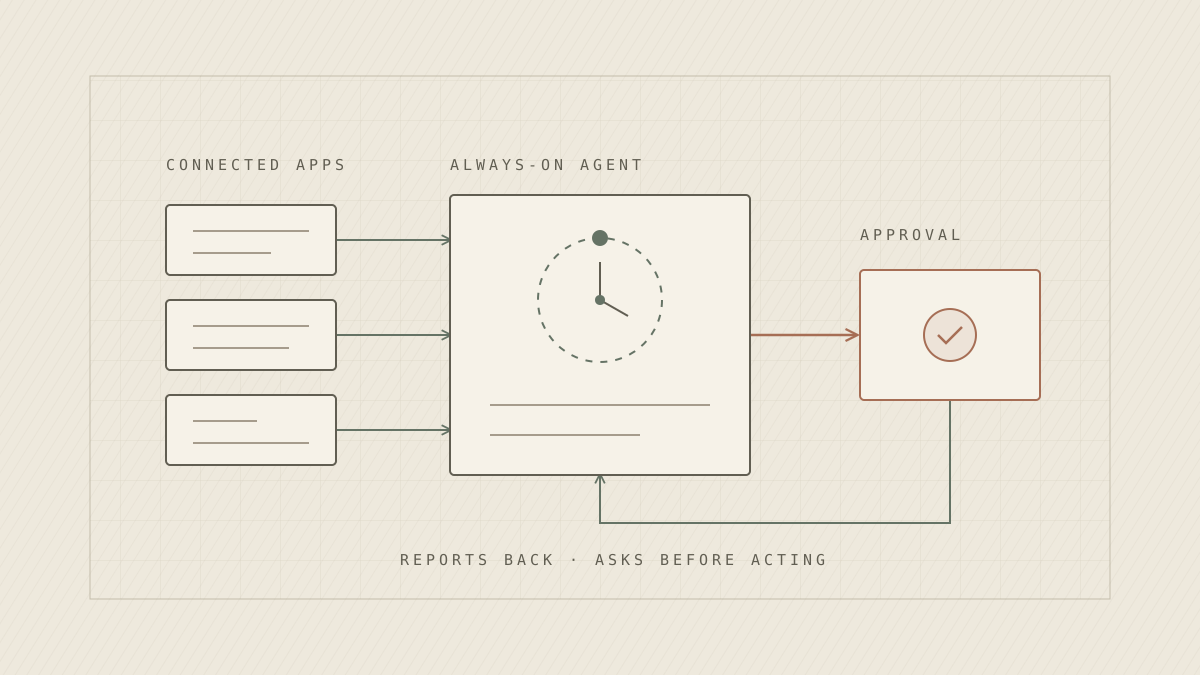
The products work in broadly the same way. Each agent runs on its own cloud computer, connects to your email, calendar and other apps, and messages you when something is finished or needs your approval. The differences are in who can use them, how they are billed, how much they can be personalized and how much of your data they collect.
We also compare them with Hermes Agent, the open-source agent from Nous Research that many technical users were already running before any of these launched.
The options at a glance
Details are changing quickly, and several of these products are still in beta or rolling out by waitlist. This is how they stood in late October.
| Agent | Who can use it | Personalization | Usage |
|---|---|---|---|
| Grok Bot (xAI) | SuperGrok and Cursor subscribers | Named roles and custom, even animated, avatars | Separate weekly allowance |
| Muse (Meta) | Free and paid tiers, US only | Remembers details and suggests ideas | Free tier, plus $20 and $100 plans |
| Dots (OpenAI) | ChatGPT Pro and Business Premium | Name, avatar, character or pet | Conversations don't count; Codex tasks do |
| Duet (Anthropic) | Claude Pro and Max, US waitlist | Shares Claude's memory, skills and connectors | Counts toward plan limits |
| Task (Google) | Google AI Pro and Ultra | Scheduled tasks inside the Gemini app | Gemini plan limits; up to 15 tasks at once |
| Instinct (Spear Street Technology) | Invite only | Lives in iMessage, WhatsApp and phone calls | Free during beta |
| Hermes Agent (Nous Research) | Anyone who can host it | Any model, skills, memory, interfaces | You pay for hosting and model usage |
Each agent collects different amounts of data
An always-on agent is only useful if it can see your inbox, calendar and accounts. That makes the provider's data practices more important than they are for a chatbot you open occasionally.
Surfshark's latest review of AI app privacy labels gives a sense of the range. Using the data types each company discloses in Apple's App Store, it found that the average AI chatbot collects 13 of 35 possible types. ChatGPT, where Dots lives, collects 17. Gemini collects 24. Muse collects 31, second only to Meta AI at 33. Muse also collects precise location, sensitive information such as health and biometric data, and audio that may be used beyond core functionality. Interactions are used for AI training by default, although users can opt out in settings.
This is consistent with how Meta has always worked. Its business depends on detailed knowledge of its users, and that has led to problems with regulators before: a $5 billion FTC penalty in 2019 and a €1.2 billion GDPR fine in 2023. Surfshark makes a fair point that an agent may be more invasive than a chatbot, because it needs access to calendars, email and financial tools to do its job.
Privacy labels are self-reported and say nothing about how well data is protected, so they shouldn't be read as security ratings. They do show how much each company asks for. Before connecting an agent to work email or client accounts, find out what it will collect and whether the data will be used for training.
Personal assistants, and AI employees
Most of these products are pitched as personal assistants. Duet reviews your email and calendar each morning and drafts replies. Muse books travel, fills out forms and negotiates bills. All of them ask before sending messages, spending money or deleting anything.
Grok Bot goes furthest toward treating agents as staff. xAI calls Bots teammates, and its examples come from its own teams: sales outbound, invoices, onboarding and bug fixes. You can set up a chief-of-staff Bot that oversees the others, and each Bot has its own title and avatar, which can even be animated.
Some users model their Bots on real people. One user's team mixes role names like Content Researcher with a Steve Jobs-style adviser, an Elon Musk X content manager and a MrBeast YouTube content manager. The Bot doesn't have MrBeast's judgement, but the persona makes it feel like asking an expert and shows at a glance which Bot does what.
Dots offers a lighter version: you name your dot and pick an avatar, character or pet. Names and roles make agents easier to assign work to, but they can also make people trust them more than they should. An agent with a friendly face still needs clear permissions.
Making your existing plan go further, for now
Some of these agents don't draw on the rest of your plan's limits. xAI says Grok Bot has its own allowance, which a Cursor staff member confirmed on the Cursor forum. Since Bots can reproduce bugs, write fixes and open pull requests, developers have been handing them coding work that would otherwise use up their Cursor limits. Work a Bot passes to a Cursor agent still counts against Cursor, though.
Conversations with a dot don't count toward ChatGPT limits, but Codex tasks it starts do. Duet's background work counts toward Claude plan limits.
It's a useful way to stretch a subscription for now, but these are launch terms. OpenAI will publish per-plan terms after the first month, and some Grok Bot users are already using up the weekly allowance in three days.
Gemini Task got there early
Google announced Spark at I/O in May as Gemini's "24/7 personal agent," months before the other big labs. It runs scheduled and background tasks for Google AI Pro and Ultra subscribers, with up to 15 tasks running at once. Outside the existing Gemini subscriber base, it has received little attention.
Part of the reason is presentation. Google made Spark a mode inside the Gemini app, then renamed it Task, and moved it behind a Chat/Task switch above the prompt box. Google says testers kept saying they wanted Gemini to help them finish "tasks," hence the name. It is a sensible design, but it doesn't have a named product or face that people talk about. For people already paying for Google AI Pro, it is worth trying before signing up for another service.
Muse brings agents to casual users
Despite our concerns about data collection, Muse may be the most significant launch of the group. It topped the US free iOS chart in its first week, overtaking ChatGPT. It has a free tier and runs in WhatsApp as well as its own app.
Most people using Muse have never set up an agent, written a scheduled prompt or connected an AI system to their email. Technical users have been doing these things for a while, often with tools like Hermes, scripts and API keys. Muse makes them available to a much larger group through apps people already use. Features such as the Ideas tab, which suggests things to do, and the Goals tab, which tracks longer projects, are designed for people who wouldn't know to ask.
For organizations, this changes the situation. Employees may soon expect an agent to handle their calendar and errands, whether or not the company has approved one. It is better to choose the tool and set the permissions before people connect their own.
Instinct: an assistant you text or call
Instinct, from San Francisco startup Spear Street Technology, has no app at all. You message it in iMessage or WhatsApp, or call it, and it texts or calls you when something needs your attention. Its Concierge feature can even phone businesses for you.
Because you reach it the way you'd reach a person, it feels more like an actual assistant than the others. Still invite-only and free, it raised $250 million at a $2.5 billion valuation in August, and Meta is now testing calls in Muse.
Early users have raised concerns too. One review notes that disconnecting an account doesn't delete data already indexed from it, and that conversations are used for training by default.
Hermes: more work to set up, much more control
The hosted agents are easy to start with. You sign in, connect your accounts and start messaging. The trade-off is that the provider chooses the model, the data practices, the usage limits and which apps the agent can connect to.
Hermes Agent takes the opposite approach. It is MIT-licensed and runs wherever you host it: a laptop, a VPS, a Docker container or a managed service. You can talk to it through a terminal, Telegram, Discord, Slack, WhatsApp, Signal or email. It works with Nous Portal, OpenRouter, OpenAI or any compatible endpoint, so you can use a different model for each type of work. It keeps its own memory, turns completed work into reusable skills and has a cron scheduler for recurring jobs. It can also import settings and skills from Claude Code, Codex CLI and Cursor.
It takes more effort. Someone has to host it, update it, manage its credentials and decide what it is allowed to do. Your total cost depends on how much the models are used rather than a fixed subscription. But your data stays where you put it, you can choose any model, and nobody can change your allowance at the end of a launch month.
For technical users, teams with strict data requirements, or anyone who wants an agent tailored to particular workflows, Hermes is still the better choice. For everyone else, the hosted agents now cover the main uses well enough that setting one up yourself is optional.
Which one to choose
Start with the subscription you already have. Gemini subscribers have Task, ChatGPT Pro users have Dots, Claude Pro and Max users can join the Duet waitlist, and Cursor and SuperGrok subscribers have Grok Bot, which suits teams that want several specialized agents. Muse is the easiest to start with, but we would think carefully before connecting it to anything sensitive. If you need control over the model, the data or the infrastructure, use Hermes.
Whichever you pick, give it only the access it needs, find out whether its work counts toward your plan limits, and keep sends, purchases and deletions behind approval. These agents are useful, but they act on your behalf around the clock, so the permissions you give them deserve more attention than the name or avatar.