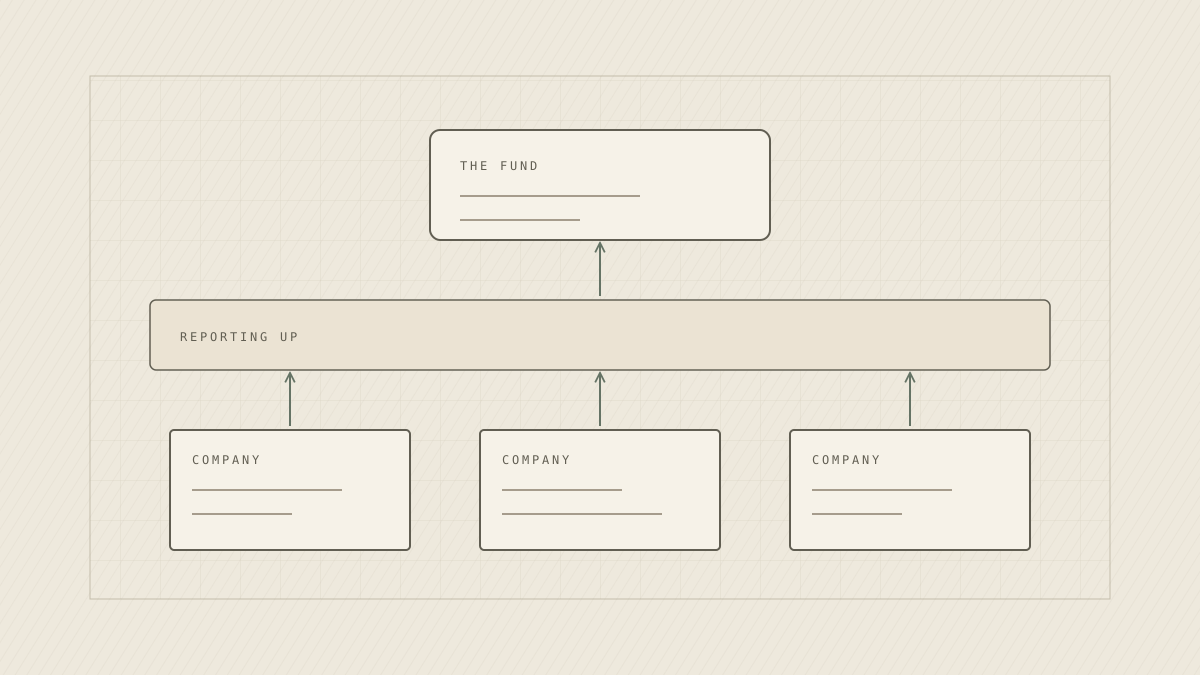
When a private equity firm asks how AI could help, the question usually means one of two different things. Sometimes it means the portfolio companies: can AI make each business run better? Sometimes it means the firm: can the fund's own team do its work with less effort? Both are real, but they're different jobs, with different owners, different data and a different payoff.
We think it helps to separate them early, and then to pay close attention to the work that sits between them, because that's where improving one makes the other easier.
Two kinds of efficiency
This is how we draw the line:
| Inside each company | At the fund | |
|---|---|---|
| The goal | Make each company run better | Run the portfolio with less effort |
| Examples | Support, engineering, sales, onboarding, finance | Consolidating numbers and decks, the monthly close, forecasting, IRR tracking, sourcing and diligence |
| Where value shows | Each company's EBITDA, and the value of the holding | The firm's margin: the team stays the same size as the portfolio grows |
| Who owns it | The value creation lead, with each company's CEO | The firm's finance and operations team |
| Whose data | Each company's own | What the companies send up |
Inside the companies: the larger prize, one business at a time
For most firms, the larger value sits in the companies. A point of margin across a business with real revenue is worth far more at exit than any saving in the fund's own team. That's also where AI projects are most likely to stall, because each company has its own systems, its own processes and its own priorities.
Our approach in each company is the same, and it rests on three tools. An evaluation of how the company actually works and where its time goes. A list of opportunities, each sized by the value it creates and the effort it takes, and each saying where its saved time will go. And a roadmap that orders them, so the first project proves its value before the next one starts. In the companies, internal processes usually offer nearer value than new AI product features, which take longer to build and longer to pay back.
We'd start in one company, where the value is highest and the team is willing, rather than across the whole portfolio at once.
Start with one use case, then look across the portfolio
Change starts small. One use case in one company, with a clear owner and a number that moves, does more for adoption than a portfolio-wide program announced from the top. It proves the value, earns the trust of the next CEO, and shows the fund what a good project looks like.
But a portfolio's total value doesn't come from running that playbook company by company in isolation. It comes from looking across the companies for what they have in common. The same gaps show up again and again: an onboarding backlog that caps new customers, a support team buried in repeat questions, a finance team that closes late. Onboarding, support and finance look more alike across businesses than their owners expect.
Once the first assessments are done, we'd lay them side by side:
- Common gaps. Which problems appear in more than one company, and where are they costing the most?
- Shared solutions. Which fixes can be built once and adapted to each company, rather than bought or built separately every time?
- Shared terms. Which tools and vendors are worth negotiating at the portfolio level, rather than by each company on its own?
- Order across companies. Which company should go first for each opportunity, so the rest follow a version that already works?
That turns a series of separate projects into a portfolio program: the second company gets the solution faster and cheaper than the first, and the fund sees value compound rather than add up.
At the fund: the same team, a bigger portfolio
The fund's biggest recurring cost is the work of managing the companies. Every month each company closes its books and sends up a deck, a P&L, a cash flow and a cash outlook, each in its own format. Someone at the fund consolidates them before anyone can see whether the portfolio is on plan. Add sourcing, diligence, deal documents and investor requests, and the team's time goes quickly.
Here the goal isn't to make anyone redundant. It's for the team to stay the same size while the portfolio grows. We'd approach it in three steps:
- Standardize. Agree one format for what each company sends up, so the numbers line up without rework.
- Consolidate and draft. Let the numbers roll up on their own, and have the monthly pack and variance analysis drafted for the team to check, not written from scratch.
- Forecast sooner. With confirmed numbers earlier, forecasting can start earlier: cash, EBITDA and IRR against target.
The payoff is a faster close, one view of EBITDA, gross profit, cash flow and IRR across the portfolio, and a team that can take on more companies without adding people.
In between: reporting is where they meet
Reporting and monitoring sit between the companies and the fund, and they're easy to overlook because neither side owns them fully. The company produces the numbers. The fund consumes them. The format, timing and definitions are negotiated, often informally, and they drift with every acquisition.
It's also the one place where a single change helps both sides. Cleaner, standard numbers from each company make the fund's consolidation faster. And a company whose finance team closes faster and reports in a standard way has usually fixed something in its own process along the way. Every new company that joins the portfolio adds to the reporting load, so the work grows with the fund unless it's made standard early.
The same applies one level down. Many funds hold platforms that grow by acquisition, with add-on companies underneath them. There, reporting rolls up twice: each add-on into its platform, then the platform into the fund. The platform's finance team is often where consolidation hurts most, because every add-on arrives with its own systems, chart of accounts and close calendar. Agreeing one format at the platform first means each new add-on is mapped once, the platform closes faster, and what it sends up to the fund is already clean.
In practice, we'd treat reporting as its own small workstream: agree the format with the companies, make producing it part of each company's close, and build the roll-up at the fund against that format.
Count value where it actually lands
Keeping the two kinds apart also keeps the numbers honest. Value inside a company should be counted in that company's EBITDA, and most of it starts as time saved, which only counts once it becomes revenue or spend that comes out. Value at the fund shows up as margin and capacity: a portfolio that grows without the team growing with it.
Mixing them makes both harder to see. A fund-level tool claimed as portfolio value creation, or a company project justified by the fund's reporting needs, tends to lose its owner and its budget. Separate the work, give each side its owner, and use reporting as the bridge.