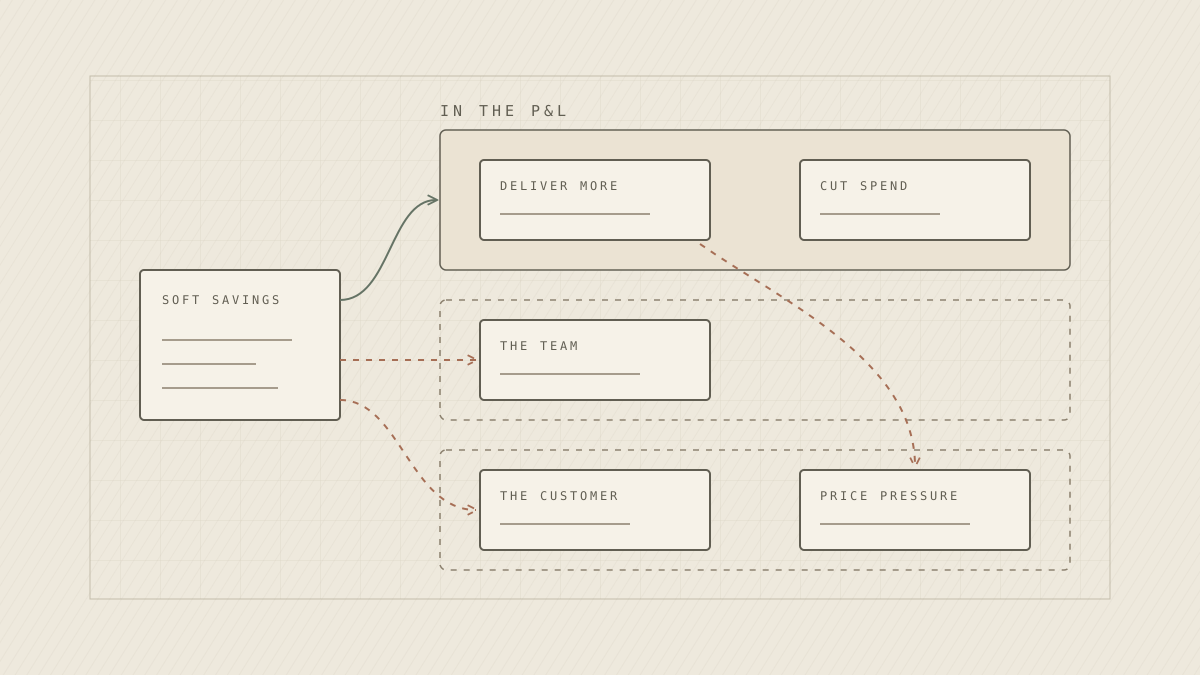
Almost every AI project we see starts the same way. A task that took an hour now takes ten minutes: drafting a reply, reconciling a report, preparing a customer for onboarding. Someone multiplies the minutes saved by the number of times the task happens and by an hourly rate, and the result goes into a business case as a saving.
We call that a soft saving, and on its own it changes nothing in the numbers. Payroll is the same. The vendor bill is the same. Revenue is the same. The time has been freed, but nobody has decided what happens to it yet.
That isn't a reason to dismiss soft savings. They're where most real AI value starts. It's a reason to follow the saved time until it lands somewhere, because where it lands decides what it's worth and who sees it.
Three kinds of value, and only two are hard
We sort AI value into three kinds:
- Revenue growth. The business delivers more work, serves more customers or wins deals it couldn't take on before.
- Hard cost savings. Spend actually comes out: fewer hires, fewer contractors, a vendor or subscription cancelled.
- Soft cost savings. A task takes less time. Nothing has moved yet.
Soft savings count only once the freed time is used to deliver more, which becomes revenue, or taken out as spend, which becomes a hard saving. Until then they're a capacity, not a result.
The saved time goes to one of three places
The useful question is not how much time a tool saves but who keeps it. In our experience, it ends up in one of three places.
The business keeps it. The freed time delivers more work and reaches more customers, or the spend comes out. These are the only two outcomes that show up in the P&L.
The team keeps it. Someone who was working overtime every week now works normal hours. Someone who spent Fridays on a report now spends them on the work they were hired for. That's a real gain, in satisfaction and retention, but it appears in no line of the P&L.
The customer keeps it. Faster turnaround and better service go straight to the customer. And part of any revenue gain ends up with them too: once customers see more delivered for the same money, they come to expect more output for each dollar, and that pushes price down over time.
| Who keeps the time | What it looks like | In the P&L? |
|---|---|---|
| The business, by delivering more | More work delivered, more customers served | Yes, as revenue |
| The business, by cutting spend | Fewer hires, contractors or vendors | Yes, as a hard saving |
| The team | Less overtime, better retention | No, but real |
| The customer | Faster turnaround, better service, some given back in price | No, and some of the revenue gain leaks here |
Most saved time leaks by default
If nobody decides where the saved time goes, it goes to the team and the customer. People fill the hour with other work, finish earlier, or do the same task more carefully. Customers get a slightly faster reply. None of that is bad, and some of it is exactly what you want. But it means a project that saved thousands of hours can finish with no visible change in revenue or cost, and the business case looks like it failed.
Recent survey data backs this up. In Hubstaff's State of the Workweek 2026, a survey of more than a thousand US office workers, three quarters of AI users who tracked their savings said they save at least an hour a week. Only 26% said they take on more work with that time. 39% said they simply finish their work earlier, and 15% said nothing really changes. At the same time, 46% said the work expected of them has gone up since they started using AI. Left alone, the time goes to the team first, and the expectations catch up later.
That's usually where the scepticism about AI savings comes from. The time was saved. It just wasn't kept.
Make every opportunity say where its time goes
When we list AI opportunities for a business, each one carries a short answer to two questions: where will the saved time go, and how much of it is likely to stay with the business? A few patterns we use:
- Tie it to a constraint. Saved time turns into revenue when it removes the thing that limits growth. If onboarding capacity caps how many new customers a team can take each month, time saved in onboarding is revenue. If it doesn't, it probably isn't.
- Tie it to a plan for spend. Saved time turns into a hard saving when there's a concrete line to remove: a contractor not renewed, a planned hire not made, a tool that's no longer needed. Absorbing growth without hiring counts, if the hiring plan says so.
- Name the team share honestly. Some of the time should go to the team. Cutting overtime on a burnt-out team is a good outcome. Write it down as that, rather than claiming it as a cost saving.
- Expect some to reach the customer. In competitive markets, a share of any productivity gain will be given back in price or service. Plan for it rather than being surprised by it.
Count it the same way every time
We'd report AI value in three columns, not one: revenue, hard savings and soft savings, with the soft savings split by where the time went. The first two belong in the financials. The third belongs in the operating review, as capacity the business has created and hasn't yet used.
That keeps the business case honest, and it turns a vague claim about saved hours into a decision someone can make: what do we want this time to become?